
NOTICE CHANGES · KEEP RECORDS · KNOW WHOM TO CALL
Dog Labor Signs
Behavior changes alone do not prove labor has begun. Use the veterinary delivery plan to interpret dog labor signs and decide what to do next.
Stage I
What happens: The cervix opens; nesting, panting, or restlessness may be noticeable.
Your action: Keep the care area quiet and record changes.
Stage II
What happens: Pushing leads to puppy delivery.
Your action: Watch progress; call promptly if delivery seems difficult.
Stage III
What happens: Placental tissue passes; this can overlap puppy delivery.
- Your action: Record what you observe without assuming the birth is complete.
Stage labels describe the birth process, not fixed time slots. Cornell Riney: normal whelping.
Signs That Labor May Be Approaching
Watch for a change from your dog's usual behavior, such as arranging bedding, seeking a quiet place, restlessness, or reduced interest in food. These observations can be relevant near delivery, but they are not a stand-alone diagnosis of labor. Cornell's whelping guidance describes behavioral changes in the context of the birth process.
In canine pregnancy, record what happened rather than writing a conclusion. “Moved bedding and kept changing resting places” gives the clinic more information than “ready to deliver.” Note when the change began, whether it continued, and anything else that concerned you. Do not wait to finish a record before calling about an urgent problem; notes are there to help the conversation.
Keep pregnancy confirmation separate from interpreting behavior. Symptoms of false pregnancy can overlap with true canine pregnancy, so nesting is not proof that puppies are present. If pregnancy has not been confirmed, tell the veterinarian that clearly. The overlap is discussed in VCA's false-pregnancy reference.
Track Temperature Alongside Other Signs
- Normal temperature reference
- 101–102.5°F
- Possible pre-birth change
- Below 99°F
- No labor after the drop
- Contact the clinic within 24 hours
A temporary rectal-temperature drop may occur in the 24 hours before birth, but it is not always detected. A reading is supporting information, not confirmation that delivery is progressing safely.
Normal range: AKC canine health guide. Pre-birth drop: Cornell Riney normal whelping. No labor after the drop: VCA problems-at-birth guidance.
- Have the clinic demonstrate how to take a rectal reading safely before trying it at home. Stop if the dog is distressed.
- Record the reading, its time, and any behavior changes together. Bring that log to a call about possible labor.
- If labor has not started by the end of that monitoring window, contact the clinic. Seek help sooner for illness or difficult delivery; do not wait for the temperature threshold.
Signs Labor Has Started
Visible pushing or abdominal straining is different from simply rearranging bedding. Once a puppy is being delivered, birth is underway. If you see effort without progress, cannot tell what is happening, or think a puppy may be stuck, call for veterinary help rather than trying to identify a stage from an online description.
- Tell the clinic whether you are seeing behavior changes, repeated pushing, visible discharge, or a puppy at the opening. These are more useful descriptions than a guessed stage label. Say whether any puppies have already been born and explain what has changed since then. Answer the clinic's questions as directly as you can and say when you are uncertain.
Follow the contact instructions in your delivery plan. A calculator date cannot identify active labor or tell you whether a birth is progressing normally. If the plan does not cover what you are observing, ask for guidance now rather than treating the absence of an exact matching instruction as reassurance.
What Is Normal During Whelping
A mother may lick her newborn puppies, and there may be pauses between deliveries. Neither observation alone tells you that the entire birth is proceeding safely or that delivery is complete. Cornell's overview of normal whelping provides context; your veterinarian should define the monitoring plan for your dog.
Ask before the expected birth what you should record about the mother and newborn puppies. Keep the clinic's guidance beside the breeding history and any later litter-count report. When reporting progress, distinguish what you have seen from what you expected. An expected puppy count is information for the veterinarian, not a substitute for assessing the mother.
A quiet interval should not become an automatic “all clear.” If you cannot tell whether the mother is comfortable, whether more puppies are expected, or whether a newborn needs help, contact the clinic. Do not rely on another dog's birth story to decide what is acceptable in the situation in front of you.
Warning Signs: When to Contact a Veterinarian
- Persistent forceful pushing with no puppy arriving.
- A puppy appears stuck or delivery is visibly difficult.
- Heavy bleeding or foul-smelling discharge.
- Green discharge without a puppy following.
- Marked pain, exhaustion, or a mother who seems seriously unwell.
- Collapse or difficulty breathing.
Contact a veterinarian right away about heavy bleeding, foul-smelling discharge, marked pain, or a mother who appears very ill or exhausted. These are reasons to seek assessment, not to recalculate a due date. Cornell's difficult-birth guidance identifies these concerns.
- Seek urgent help if a puppy appears stuck or your dog is struggling to give birth. Do not wait for an online countdown to authorize the call. Difficulty breathing or collapse also warrants emergency veterinary attention. The relevant references are VCA’s problems-at-birth guidance and Cornell's emergency-care guidance.
When calling, state that your dog is pregnant or giving birth and lead with the most concerning observation. Explain whether a puppy is visible, whether she is pushing, and whether puppies have already arrived. Ask where to take her and what to do during transport. Have another person help with the call or travel arrangements if available.
Do not pull on a puppy or give medication to change labor without direct veterinary instructions. Ask the clinician what to do while help is being arranged. If you cannot reach your usual practice, use the emergency contact in the delivery plan; an unanswered routine message is not a completed request for urgent care.
How to Prepare Before the Day Arrives
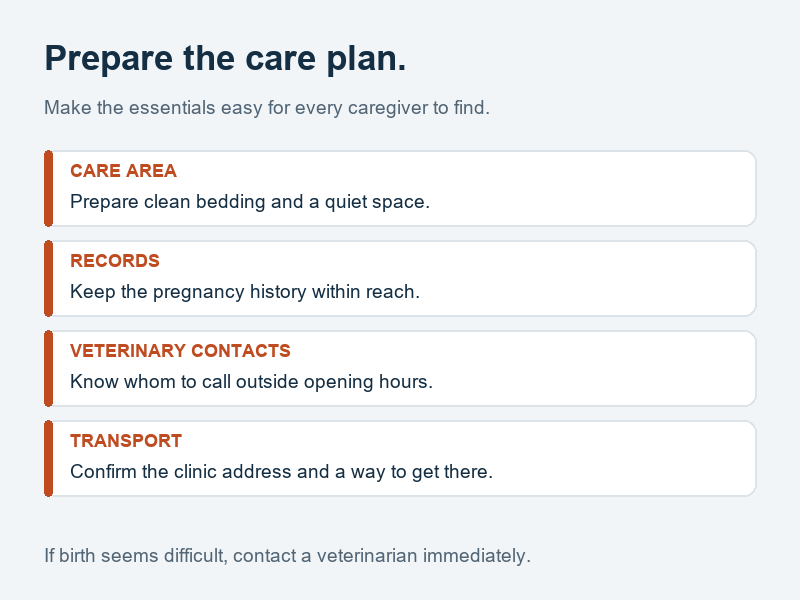
- Bedding: Clean, washable towels and replacement bedding close to the care area.
- Environment: A quiet, familiar space arranged according to the delivery plan.
- Records: Breeding dates, examination reports, and an observation log in the same place.
- Contact details: Regular and emergency clinic numbers plus the destination address.
- Transport: An available vehicle and a caregiver who knows the plan.
- Instructions: Written guidance for everyone helping; do not improvise medication or delivery maneuvers.
Agree on a delivery plan while there is time to discuss it calmly. Ask which clinic handles urgent problems outside normal opening hours, where it is located, and whether you should call before arriving. Save the contact details somewhere another caregiver can find them without needing access to your phone or an online account.
Prepare a quiet area with clean bedding and keep the clinic's instructions nearby. Discuss the setup with your veterinarian rather than purchasing equipment as a replacement for a care plan. Confirm who can stay with your dog, who can arrange transport, and where the pregnancy records are stored. Make those arrangements before signs begin.
- The due date calculator can help you organize the calendar, but the veterinary plan should guide observation and decisions about care. Share that plan with anyone helping you, including the instruction to call when something seems wrong. Avoid giving different caregivers conflicting instructions taken from unrelated websites.
Frequently Asked Questions
Does restless behavior mean I should assume delivery is underway?
No, describe the behavior and use the veterinary delivery plan to decide the next step. Contact the clinic if you are unsure what the change means.
What should I tell the emergency clinic about a difficult birth?
Describe the mother's condition, any pushing or discharge, and whether a puppy is visible or puppies have already been born. Give the clinic your location and ask where to go.
Should I wait for the estimated due date before calling about a problem?
No. A calendar estimate is not a reason to delay veterinary help when your dog appears unwell or is struggling to deliver.
Can I decide delivery is finished because my dog is resting?
Resting alone does not establish that delivery is complete. Ask your veterinarian how to assess progress using the care plan and available records.
How can someone else help while I contact the vet?
They can locate the records, confirm the clinic address, and arrange transport while you describe the problem. Make sure they follow the same veterinary instructions rather than improvising treatment.